Rafo and Marta’s warm bond and his attachment to her family
Cry MachoRafo and Marta’s warm bond and his attachment to her family develop through acts of practical care and an imagined family life that briefly seems within reach. Marta’s food, household, and presence give Rafo a sense of belonging in Janasco; when Mike prepares to leave, Rafo’s wish to stay reveals how deeply that belonging has taken root.
Food, gratitude, and welcome
The relationship is first made tangible through food. After Rafo complains about canned goods and tortillas that are never hot enough, Mike proposes buying ingredients for both themselves and Marta’s family so that she can cook. The meal Rafo has been hinting at arrives in a great red earthenware pot, rich with lamb, herbs, spices, chilis, and tomatoes, with tortillas kept warm over an improvised brazier. Rafo’s delighted questions about who sent it make clear that he recognizes the gesture. The meal is not simply relief from poor provisions: he and Mike eat until the pot is empty, and Rafo’s first concern afterward is to return it so they can thank Marta.
That insistence gives Rafo’s attachment a form of its own. He does not treat the pot as a useful object to keep or as an occasion to ask for more food; he wants to carry it back and acknowledge the person who shared the meal. When he and Mike return it, Rafo calls Marta a beautiful señora. His remark is an open expression of admiration, while Mike’s embarrassed thanks and desire to say more establish that Marta matters to both of them, though in different ways. Marta laughs, welcomes them inside, and the encounter moves from a meal sent to the men toward contact with her household.
A place in Marta’s household
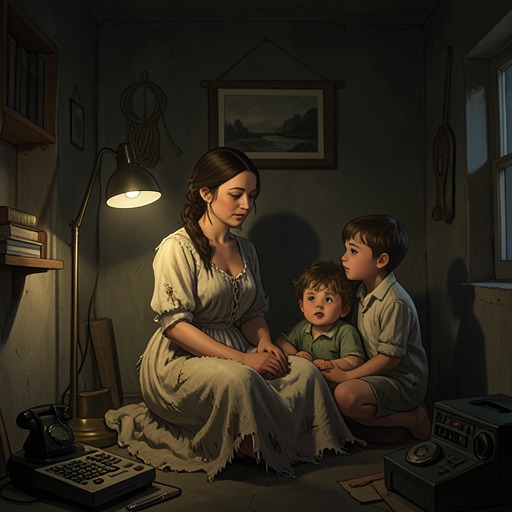
Marta’s family life gives Rafo something larger than hospitality. In her home, the children are working together with hempen cord on carriers made by the Indian exatlan method. The details of the craft and the children’s uneven progress present a busy, shared household rather than an abstract refuge. When Pepe struggles with the cord, Rafo goes to help him; Pepe’s angry refusal interrupts the attempt, and Nita instead summons Mike. The moment is small and not entirely successful, but it places Rafo among the family’s ordinary interactions, where help is offered, refused, and redirected.
The bond is also shaped by the life Rafo imagines around Marta. When Mike suggests cooking for the family, Rafo glows at the prospect of a noisy dinner with all the children gathered in a circle, with Mike and Marta eating among them and trying, unsuccessfully, to quiet the children. Mike shares the vision. It remains an imagined meal rather than an event: when they reach Marta’s home, they discover that the family’s cow is dying, and the emergency displaces the planned dinner. The contrast matters. Rafo’s picture of belonging is built from ordinary abundance and company, but the household’s precarious circumstances can abruptly turn a hoped-for gathering into a crisis.
Shared crisis and practical care
During the cow’s illness, Rafo becomes an essential intermediary between Marta and Mike. When Mike tells him to go away, Rafo answers that Marta needs to know what to do and that without him she will not be able to communicate with Mike. He translates her questions as the animal’s condition worsens, including her wish to know whether Mike has a gun and her reluctance to let the cow die by burning. Rafo is therefore not only emotionally attached to Marta’s household; his ability to bridge the language gap helps the adults respond to an immediate danger.
The crisis also shows how closely Rafo’s loyalties are involved. He had been on Marta’s side, then comes to support Mike’s judgment that the animal must be killed, not wanting Marta to refuse this time. His role does not erase the difference between them or make the decision easy. Instead, he carries information and feeling between them while the household confronts the loss of its animal. When Marta catches fire and runs into the field, Mike tackles her and rolls against her to extinguish the flames, then carries her back toward the house. Rafo’s relationship with Marta sits within this wider circle of care: he helps her understand what must happen, while Mike acts to save her from further injury.
Leaving Janasco
Rafo’s attachment becomes clearest when departure threatens it. He reminds Mike that they are supposed to go to Marta that night, relying on what Mike had said earlier. The reminder makes the visit an expectation Rafo has held onto, not an incidental stop. Later, as they prepare to leave Janasco, Mike remembers that much of what he and Rafo have done on the mesa has been shared: their first night there, their first captured horse, and the moments when fear gave way to hope. Against that history, Rafo says he does not want to leave.
When Mike argues that Rafo is a rich child and need not live in a poor town, Rafo rejects the distinction between material wealth and the life he has actually experienced. He says that the first time he felt rich was when they earned a few pesos selling horses, and that Janasco is the only place where he has been happy and the first place he has had a home. His plea to stay gives Marta and her family an important place in that sense of home, even though he does not reduce the feeling to one person alone. The bond’s significance lies in this widening of Rafo’s world: food shared, a pot returned in gratitude, children and household work, and a hoped-for visit become part of the community he cannot bear to leave.